
Why Athletes Should Never Skip Recovery After a PR
Setting a personal record is one of the best feelings in sport. Whether you just crossed a finish line faster than you ever have, lifted more than you thought possible, or hit a performance benchmark you have been chasing for months, a PR represents real progress. It is evidence that your training is working and your body is adapting.
Here is the part most athletes do not want to hear: the moments immediately following a PR are exactly when your body is most vulnerable. Skipping recovery after a peak performance effort is one of the most common and most costly mistakes in competitive and recreational athletics alike. At Prime Sports Institute in downtown Bellingham, WA, we work with athletes every day who are navigating the demands of training hard and recovering well. Understanding why recovery after a PR is non-negotiable is the first step toward staying healthy long enough to break that record again.
What Actually Happens to Your Body After a PR Effort
A personal record, by definition, means you pushed your body beyond what it has done before. That sounds like a victory, and it is. But it also means your musculoskeletal, cardiovascular, and nervous systems have been stressed to a new ceiling. The tissues that carried you to that performance are not in the same condition they were before the effort.
Muscle Damage and Inflammation
High-intensity efforts that produce PRs, whether in running, lifting, cycling, or any other sport, create microscopic damage to muscle fibers. This is a normal and necessary part of how your body builds strength and fitness. The adaptation process requires that damage to occur. But the repair process that follows is where the actual gains are made, and it requires time, rest, and proper support to complete fully.
When athletes skip recovery and return to hard training too soon after a PR effort, they are layering new stress onto tissue that has not yet finished repairing. The result is cumulative fatigue, degraded performance, and a significantly elevated injury risk. The very gains that produced the PR begin to erode rather than compound.
Central Nervous System Fatigue
One of the most underappreciated aspects of post-PR recovery is the toll on the central nervous system. True peak efforts, the kind that produce personal records, draw heavily on CNS resources. Motor unit recruitment, coordination, reaction time, and mental focus all depend on a nervous system that is rested and recovered. CNS fatigue does not show up as sore muscles. It shows up as sluggishness, poor coordination, reduced motivation, and a persistent feeling of flatness in training that athletes often misread as a need to push harder rather than a signal to back off.
Recognizing and respecting CNS fatigue is one of the areas where working with experienced sports medicine professionals makes a real difference in how athletes manage their training and recovery cycles.
Related: How Trigger Point Therapy Works and Who It's Best For

The Injury Risk Window After Peak Performance
The period immediately following a PR is not just a recovery window. It is a vulnerability window. Your body has demonstrated what it is capable of, but it has also revealed exactly where it is operating at or near its structural limits. Tendons, ligaments, and joint tissues that were under maximum load during a peak effort are more susceptible to injury in the days following that effort, particularly if training volume or intensity is not reduced appropriately.
Overuse Injuries That Follow Ignored Recovery
Skipping recovery after a PR and returning to high training loads is one of the most reliable pathways to overuse injuries. Stress fractures, tendinopathies, IT band syndrome, plantar fasciitis, and rotator cuff issues all develop through the same fundamental mechanism: repetitive load applied to tissue that has not been given adequate time to adapt and repair.
At Prime Sports Institute, ourathletic training team sees this pattern regularly. An athlete achieves something remarkable, feels invincible, pushes through the recovery period, and arrives weeks later with an injury that sidelines them for far longer than a few easy recovery days ever would have. The prevention philosophy our athletic trainers live by is built on recognizing and treating minor issues before they progress into something much worse.
Related: How Manual Therapy Supports Recovery Between Training Cycles
What Smart Post-PR Recovery Actually Looks Like
Recovery is not simply doing nothing. For athletes serious about continued performance improvement, post-PR recovery is an active process that accelerates tissue repair, reduces inflammation, and prepares the body for the next training cycle.
Guided Recovery Sessions at Prime
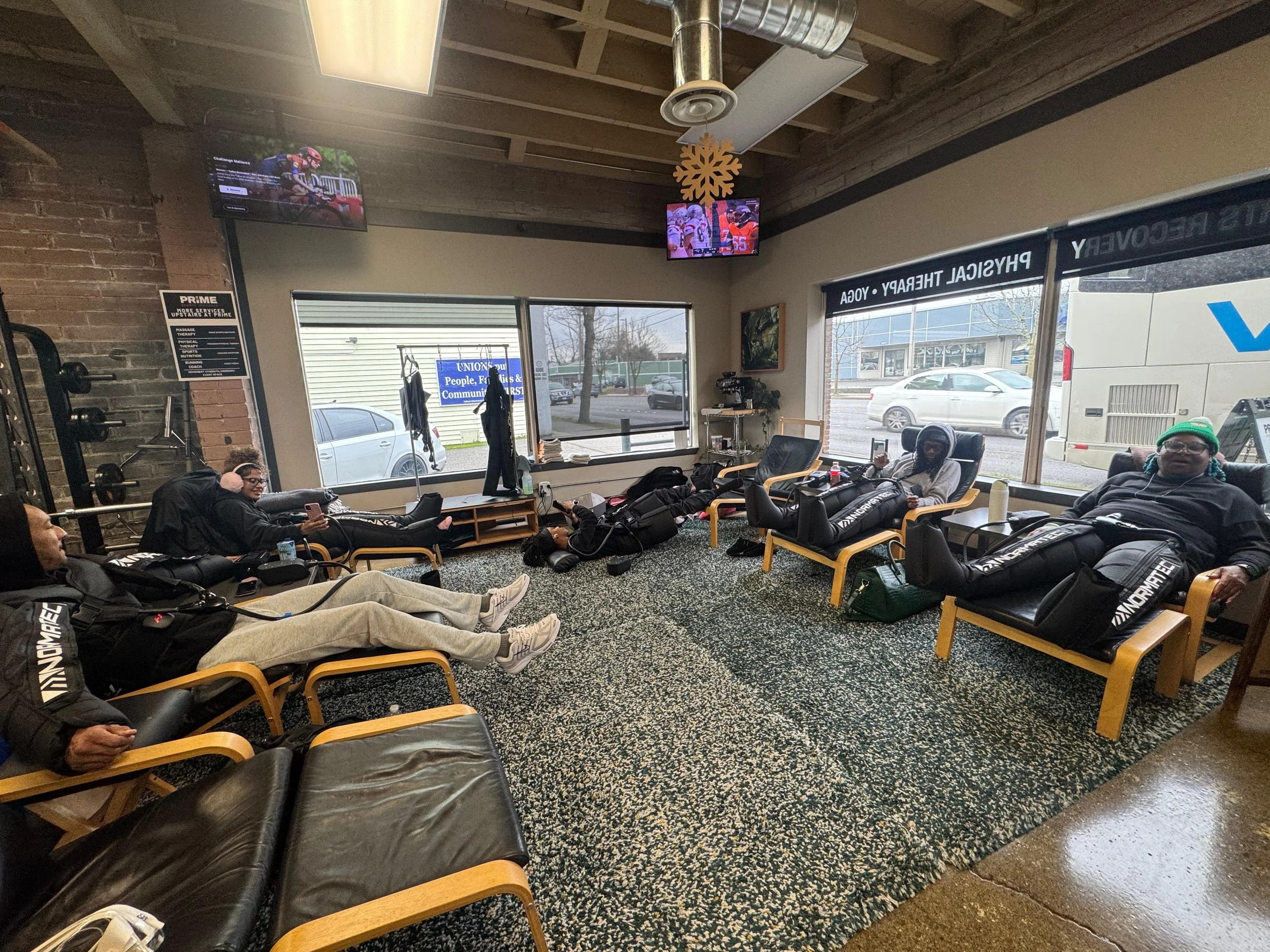
At Prime Sports Institute, our guided recovery sessions in the Prime Training Room give athletes access to the same recovery tools used by elite and professional athletes, with expert guidance on how to use each one effectively based on how they feel that day. A post-PR recovery session might include NormaTec compression to reduce swelling and improve circulation through the legs, GameReady for targeted cold and compression therapy on areas of acute stress, contrast tubs alternating between hot and cold immersion to drive metabolic clearance and reduce inflammation, cold laser therapy to accelerate tissue recovery at the cellular level, and FAR infrared sauna to promote circulation and parasympathetic recovery.
The real value of a guided session is not just the equipment. It is having a knowledgeable staff member walk you through a plan built around your specific effort and how your body is responding to it. You do not have to walk in knowing what you need. That is what we are here for.
Sports Massage as a Recovery Tool
Sports massage is one of the most effective tools available for post-PR recovery and one of the most underused. Deep tissue work and myofascial release in the hours or days following a peak effort helps clear metabolic byproducts from the muscles, reduces the buildup of adhesions in fatigued tissue, and restores range of motion that tightens significantly after high-intensity efforts. Our licensed massage therapists at Prime customize every session around your specific performance demands and recovery needs, and sessions are available in 30, 60, and 90-minute formats to fit your schedule.
Athletic Training Evaluation After a Hard Effort
If something feels off during your PR attempt, or if you are noticing tightness, soreness, or discomfort in a specific area in the days following, an athletic training evaluation is worth scheduling before you return to full training. Our athletic trainers diagnose injuries, identify imbalances, and provide hands-on treatment including soft tissue work, cupping, Graston technique, manual therapy, and assisted stretching. Catching something early after a peak effort costs far less in time and setbacks than waiting until a nagging issue becomes a sidelining injury.
Related: Pre-Event vs. Post-Event Recovery: Creating a Holistic Recovery Plan
Recovery Is How You Set the Next PR
The athletes who break their personal records consistently are not necessarily the ones who train the hardest. They are the ones who train smart enough to stay healthy, recover well enough to absorb their training, and show up to their next peak effort fresher and more prepared than the last time.
Recovery is not a sign of weakness or lost momentum. It is the mechanism through which your body converts the stress of a peak performance into a new baseline. Skip it, and you are leaving the gains from your PR on the table. Invest in it, and you create the conditions for the next one.
At Prime Sports Institute, we are here to support every part of that process. Our team is located at 1704 N. State St. in downtown Bellingham, WA, and our Training Room is open six days a week for guided recovery sessions. Schedule your session today and give your body what it earned.
